
Ligament Injury Treatment: A Complete Guide to Healing the Right Way
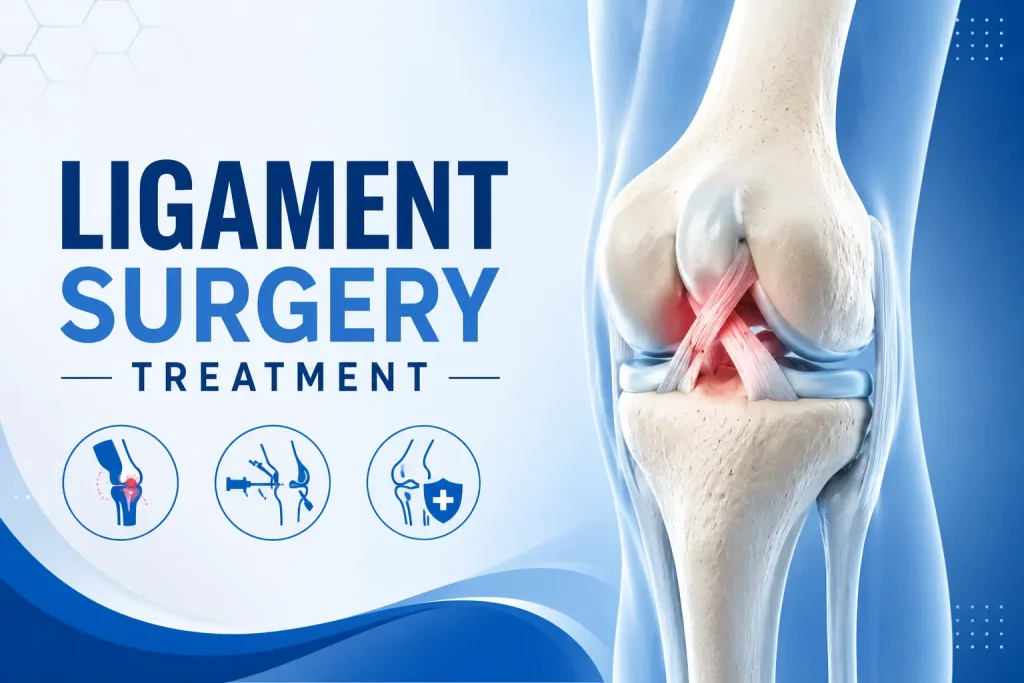
Key Takeaways • Ligament injuries range from mild stretching (Grade 1) to complete tears (Grade 3), and the treatment plan changes with each grade. • Most Grade 1 and Grade 2 ligament injuries heal well with rest, protection, physiotherapy and pain management, without any surgery. • Ignoring a ligament injury or returning to activity too early is the most common reason for long term joint instability. • Warning signs such as a popping sound, rapid swelling or the joint giving way need a medical assessment within 24 to 48 hours. • A structured recovery plan guided by a qualified specialist protects the joint and lowers the risk of repeat injury. |
A sudden twist on the football ground, a missed step on the staircase or an awkward landing during a badminton game. Ligament injuries often begin with one ordinary moment. What follows is pain, swelling and a question that troubles every patient: will this heal on its own or does it need proper treatment?
The honest answer depends on which ligament is injured and how badly. Some injuries settle with two weeks of care at home. Others, when neglected, turn into years of joint instability and early arthritis. This guide explains ligament injury treatment in simple terms, covering grades of injury, non surgical and surgical options, recovery timelines and expected costs, so that you can make an informed decision about your own care.
Ligament Injuries at a Glance: Key Statistics
Statistic | Figure | Source |
Share of sports related injuries that involve ligaments and other soft tissues | Around 40 to 50 percent | Industry estimate |
Most commonly injured knee ligament in sports | Anterior cruciate ligament (ACL) | PubMed indexed orthopaedic literature |
Ankle sprains among all sports injuries | Roughly 15 to 20 percent | Industry estimate |
Grade 1 and Grade 2 injuries managed without surgery | Majority of cases | PubMed indexed orthopaedic literature |
Typical recovery window for a mild ligament sprain | 2 to 6 weeks | Industry estimate |
What Is a Ligament Injury?
A ligament is a tough, elastic band of connective tissue that holds two bones together at a joint. Think of ligaments as the seat belts of your joints. They allow normal movement while preventing the bones from moving too far in the wrong direction.
A ligament injury, commonly called a sprain, happens when the joint is forced beyond its normal range. The ligament may stretch, partially tear or rupture completely. The knee, ankle, wrist and shoulder are the joints most often affected. Because ligaments receive less blood flow than muscles, they need more time and more careful handling to heal properly.
Grades of Ligament Injury
Doctors classify ligament injuries into three grades. This grading decides the entire treatment plan, which is why an accurate diagnosis matters so much.
Grade | What Happens | Common Symptoms | Usual Treatment |
Grade 1 (Mild) | Ligament fibres are stretched but not torn | Mild pain and tenderness, minimal swelling, joint remains stable | Rest, ice, compression, elevation and gradual return to activity |
Grade 2 (Moderate) | Partial tear of the ligament | Moderate pain, visible swelling, bruising, some looseness in the joint | Bracing or support, physiotherapy, pain management, activity modification |
Grade 3 (Severe) | Complete tear or rupture of the ligament | Severe pain at injury followed by instability, major swelling, inability to bear weight | Specialist assessment, structured rehabilitation, surgery in selected cases |
Common Types of Ligament Injuries
Knee Ligament Injuries
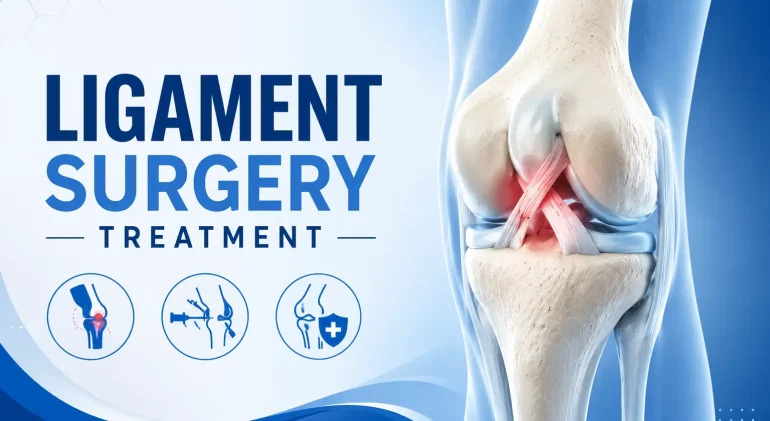
The knee has four main ligaments: the ACL, PCL, MCL and LCL. The ACL is the most frequently injured, especially in sports that involve sudden stops, jumps or changes of direction such as football, kabaddi and badminton. MCL injuries usually follow a direct blow to the outer side of the knee.
Ankle Ligament Injuries
An ankle sprain is the most common ligament injury in everyday life. It typically occurs when the foot rolls inward on an uneven surface. Repeated sprains that are not rehabilitated properly can lead to chronic ankle instability.
Wrist and Shoulder Ligament Injuries
Falls on an outstretched hand often injure wrist ligaments, while shoulder ligament injuries are common in overhead sports and in road accidents. Both need careful evaluation because these joints depend heavily on soft tissue for stability.
Symptoms That Need Medical Attention
Not every sprain needs a clinic visit. However, you should consult a specialist within 24 to 48 hours if you notice any of the following:
- A popping or snapping sound at the moment of injury
- Swelling that develops rapidly within the first few hours
- Inability to put weight on the leg or use the joint normally
- A feeling that the joint is loose, unstable or giving way
- Pain that does not improve after 3 to 4 days of rest and home care
- Numbness, tingling or skin discolouration around the joint
These signs point towards a Grade 2 or Grade 3 injury. Early diagnosis through clinical examination, and an MRI where required, prevents a manageable injury from becoming a long term problem.
Ligament Injury Treatment Options
1.First 48 to 72 Hours: The PRICE Protocol
Immediate care follows the PRICE method: Protection, Rest, Ice, Compression and Elevation. Protect the joint from further stress, rest it, apply ice packs for 15 to 20 minutes every 2 to 3 hours, use a compression bandage and keep the limb elevated. This simple routine controls swelling and creates the right environment for healing.
2. Surgical Treatment
Surgery is reserved for complete tears in specific situations, for example an ACL rupture in a young athlete, multiple ligament injuries or a joint that remains unstable despite good rehabilitation. Modern arthroscopic techniques use small incisions and allow earlier rehabilitation. Even after surgery, the final outcome depends on disciplined physiotherapy
3.Non Surgical Treatment
Most ligament injuries heal without surgery when treated correctly. A complete non surgical plan usually includes:
- Bracing: Bracing and support to protect the healing ligament while allowing safe movement
- Physiotherapy: A structured, phase wise exercise programme that restores strength, balance and joint control
- Medication: Short courses of anti inflammatory medicines prescribed by a doctor, never self medicated for weeks
- Interventional pain management: For persistent pain, image guided injections and regenerative options such as PRP therapy may be considered by a pain specialist in suitable patients
Non Surgical vs Surgical Treatment: A Comparison
Factor | Non Surgical Treatment | Surgical Treatment |
Best suited for | Grade 1 and Grade 2 injuries, low demand patients | Complete tears in active patients, unstable joints |
Hospital stay | Not required | Usually 1 to 2 days |
Recovery time | 2 to 12 weeks depending on grade | 6 to 9 months for full sports return |
Main advantage | No surgical risk, lower cost | Restores stability in complete tears |
Main limitation | May not fully stabilise a complete tear | Cost, surgical risks, longer rehabilitation |
Recovery Timeline: What to Expect
Injury Grade | Typical Recovery Period | Milestones |
Grade 1 | 2 to 6 weeks | Pain settles in days, normal walking within 1 to 2 weeks, sports after clearance |
Grade 2 | 6 to 12 weeks | Brace support initially, progressive strengthening, gradual return to activity |
Grade 3 (non surgical) | 3 to 6 months | Extended rehabilitation focused on stability and strength |
Grade 3 (post surgery) | 6 to 9 months | Staged physiotherapy, running by 3 to 4 months, sports after functional testing |
Cost of Ligament Injury Treatment in Pune
Treatment costs vary with the grade of injury, the joint involved and the type of care needed. The figures below are indicative ranges for Pune and surrounding areas.
Treatment Component | Approximate Cost Range (INR) | Source |
Specialist consultation | Rs. 500 to Rs. 1,500 | Industry estimate |
MRI scan of one joint | Rs. 4,000 to Rs. 10,000 | Industry estimate |
Physiotherapy (per session) | Rs. 400 to Rs. 1,000 | Industry estimate |
PRP therapy (per session) | Rs. 8,000 to Rs. 20,000 | Industry estimate |
Arthroscopic ligament reconstruction | Rs. 1,00,000 to Rs. 2,50,000 | Industry estimate |
Ligament Injury Treatment in Pune: Why Early Specialist Care Matters
A ligament injury is not just a sprain to be walked off. It is a structural injury to the very tissue that keeps your joint stable. With an accurate diagnosis, the right grade based treatment and disciplined rehabilitation, most patients return to a fully active life. The key is to act early rather than wait for the pain to decide for you.
If you are struggling with a recent injury or long standing joint pain that has not improved, expert help is available close to home.
Book a consultation with Dr. Pravin Deokate for a detailed assessment and a personalised ligament injury treatment plan.
Visit : https://drpravindeokate.in/
Call the clinic today to take the first step towards a stable, pain free joint.